
Spatial language with blocks: above, below and between
Explore positions in Spanish and English through building play, with adult support and room for children’s own ideas.
Families and teachers
Article by the Lola & Sam team. Sources at the end.
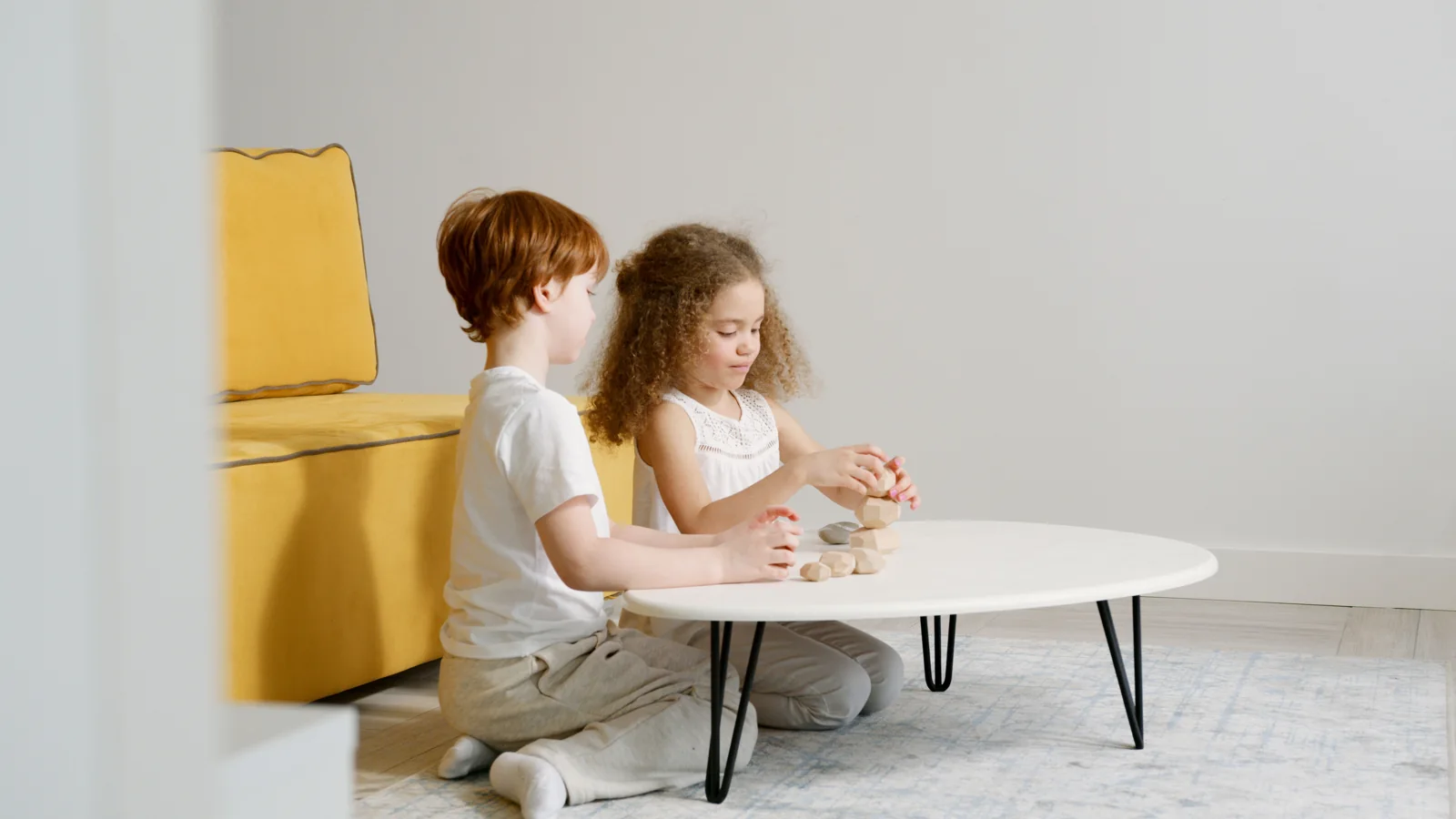
Spatial language with blocks: try “a bridge to travel under” with support matched to your child. A long piece rests across two blocks. Your child calls it a bridge and looks for somewhere to put a car. This is an opportunity for words: “The car goes underneath” or “Let’s put another block on top.” You do not need to stop the building for a lesson. Offer a simple challenge for placing, looking, changing and explaining.
At a glance
- Suggested ages: 3–4, 4–5, 5–6 years.
- Materials: Large age-appropriate blocks, a stable long piece and a large toy vehicle. Sturdy boxes and a car picture can replace them. Build on the floor or on a low surface.
- Key idea: Introduce the vehicle and challenge: it needs to get from one side to the other. Let the child explore the pieces before suggesting a particular structure.
Spatial language with blocks: what to notice
For this activity, choose a spatial relationship that is easy to see: above, below, inside or between. Say the word while placing a block, then let the child try. Ask an open question such as “Where can the car fit?” without stacking up instructions. If they begin building something else, look for a place for the vocabulary in their own idea.
Use another piece as a reference so that “above” means something concrete. “Put it there” may keep the game moving, but you can also say “on top of the blue block” and look at the position together. The goal of this activity is not a list to recite: it is having words to talk about a construction.
What the Block Talk study found
Ferrara and colleagues compared free block play, guided play and play with preassembled structures. In the guided condition, adults used a greater proportion of spatial language than in the other conditions; children also used more than during free play. The measured outcome was language during play. This does not establish a general improvement in intelligence or assess our bilingual activity.
Source: Ferrara et al. (2011).
Support building without directing every block
Your role can be to offer a visible problem: a car needs a passage, or a toy animal needs a space. Then notice what the child tries. Hold a base, bring a piece closer or describe a position if helpful. If every move depends on an instruction, swap roles: let the child build and ask where to place your own block.
If the structure falls, look at what changed and decide whether to rebuild. There is no need to correct the position, shape name, colour and sentence at the same time. Choose one language aim for this activity and let the other details remain part of the play.
From an episode to blocks, in either language
A short Lola & Sam section about shapes or toys can help you choose the pieces and theme. Then turn off the screen and make your own construction. Use a picture to recall the theme if helpful, without requiring an exact copy of what you watched. Your bridge or house can also change as the game continues.
To practise Spanish from English, give an understandable instruction and model “debajo del puente” while moving the car. In the other direction, use “under the bridge”. Pointing or placing a piece also allows participation. These equivalents are examples for our activity, not a promise of bilingual learning demonstrated by the study.
A bridge to travel under · setup and steps
You will need: Large age-appropriate blocks, a stable long piece and a large toy vehicle. Sturdy boxes and a car picture can replace them. Build on the floor or on a low surface.
- Introduce the vehicle and challenge: it needs to get from one side to the other. Let the child explore the pieces before suggesting a particular structure.
- Build a first version of the bridge. Describe an action as it happens: “The long piece is on top of the blocks.” Keep the structure low and stable.
- Invite the child to see whether the car fits underneath. If it does not, look at the gap and choose a change; an adult can support the blocks during the test.
- Let the child choose a position for the vehicle and describe it in a short phrase. Model an expression in the language you are practising if helpful.
- Finish by inviting the child to show the route they invented. If they want another round, change one condition, such as a wider vehicle or a second passage.
Words to share
Español: El coche pasa por debajo del puente.
English: The car goes under the bridge.
Español: La pieza larga está encima.
English: The long block is on top.
Español: ¿Qué podemos poner entre estos bloques?
English: What can we put between these blocks?
How to adapt it
Make it simpler
Prepare a low, stable structure yourself and offer two places for the car. Describe the chosen place without requiring the child to repeat the sentence.
Extend the game
Invite the child to give instructions for you to build. Ask them to demonstrate any instruction that needs clarification with a gesture, and check the result together.
At home
Keep a photograph of the construction if your child wants to return to it. Next time, choose which part to keep and which to change, using the same spatial words.
In the classroom
Prepare tables or areas with enough large blocks. Support one construction at a time and note a phrase or gesture you observe; allow different designs with the same spatial aim.
We are looking for an opportunity to explore and talk about positions. The construction belongs to the child; adapt words and support to what is happening.
Activities to keep exploring


Sources and further reading
- Ferrara, K., Hirsh-Pasek, K., Newcombe, N. S., Golinkoff, R. M., & Lam, W. S. (2011). Block talk: Spatial language during block play. Mind, Brain, and Education, 5(3), 143–151. DOI: 10.1111/j.1751-228X.2011.01122.x. Read the study ↗
These games are Lola & Sam’s own suggestions. Course guides and professional guidance provide educational context; they do not establish the effectiveness of these activities. The cited studies do not evaluate our episodes or materials either.