
Bilingual children: myths about confusion and speech
Mixing languages does not show confusion. Research and a game for talking without demanding translations or comparing two word lists.
Families and teachers
Article by the Lola & Sam team. Sources at the end.

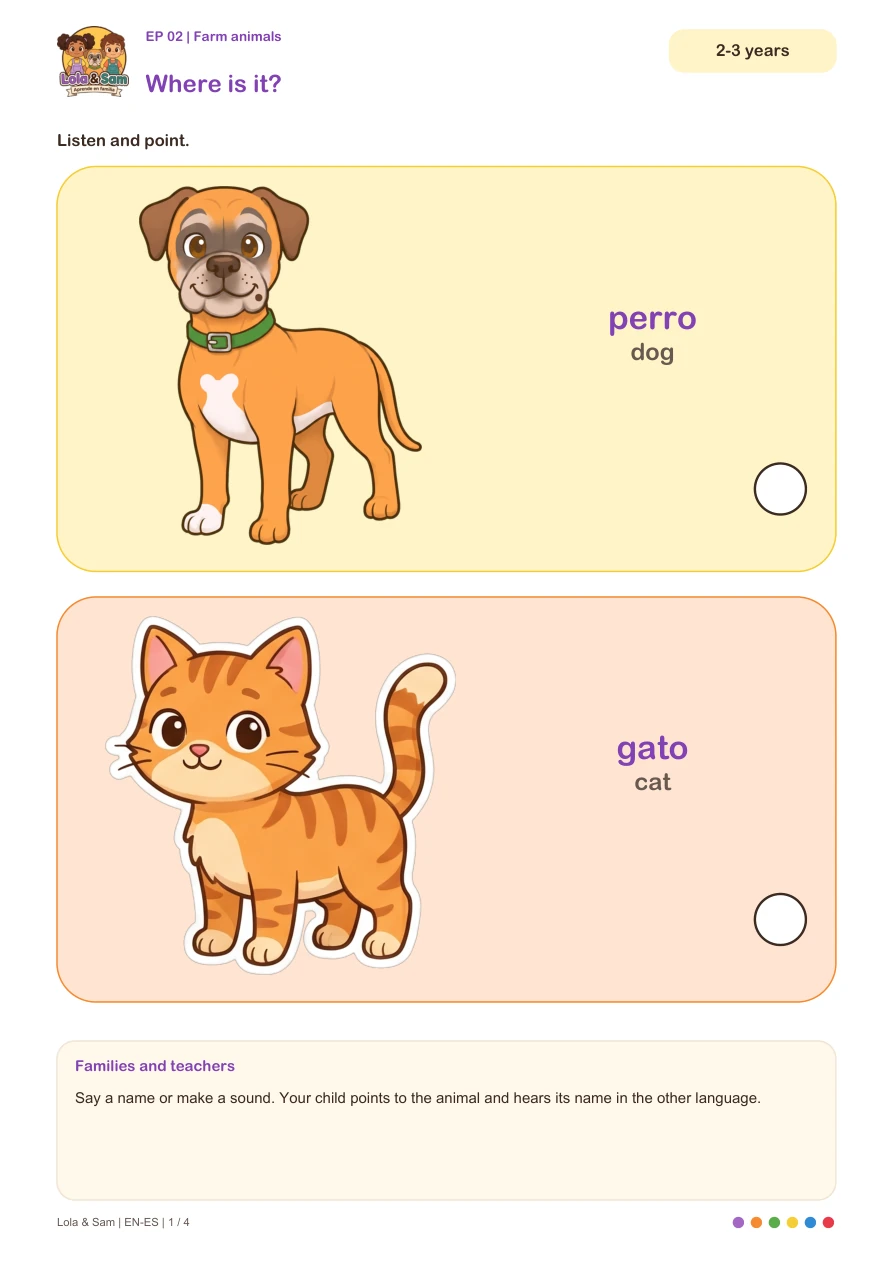
Bilingual children: try “a shelter for each animal” with support matched to your child. “I want el perro.” The sentence arrives just as someone asks whether two languages might be too much. Instead of asking your child to start again, respond to their meaning: “Yes, the dog. The dog is here.” There will be other chances to hear perro. The game below offers animal conversations without turning them into a translation test.
At a glance
- Suggested ages: 2–3, 3–4, 4–5, 5–6 years.
- Materials: Three large toy animals or episode 02 pictures, and two open boxes.
- Key idea: Choose an animal and show a shelter: “The dog sleeps here.” Move it into place.
Bilingual children: what to notice
Byers-Heinlein and Lew-Williams explain that language mixing is part of bilingual development and does not show confusion. Their review also finds that bilingualism itself does not cause more language disorders. This is an academic synthesis, not an individual assessment.
For our game, avoid keeping a score for each language. Note a specific moment: your child requested an animal, understood an instruction or said something about the picture. These notes help you choose support for the next turn; they do not measure development.
Source: Byers-Heinlein & Lew-Williams (2013).
Distinguish learning English from a difficulty
DfE guidance says that learning English as an additional language is not itself a special educational need; home communication matters too. This guidance concerns English settings and offers no universal timetable.
If you are concerned about communication, share examples from both languages and the situations where they are used with your child’s paediatrician or language professional. Do not automatically attribute a difficulty to two languages. This article cannot replace that assessment or dismiss a concern.
A shelter for each animal · setup and steps
You will need: Three large toy animals or episode 02 pictures, and two open boxes.
- Choose an animal and show a shelter: “The dog sleeps here.” Move it into place.
- Invite another choice. Follow it whether it comes through a gesture or a mixture of words.
- Add a phrase in the other language on a later turn: “El perro está durmiendo.” Do not require a translation before playing.
- Swap roles: your child places the animals and you ask where yours can go.
Words to share
Español: El perro necesita una casa.
English: The dog needs a home.
Español: Puedes enseñármelo.
English: You can show me.
How to adapt it
Make it simpler
Offer two animals and accept handing one over without naming it.
Extend the game
Invent a short story about who visits the shelter and why.
At home
Keep the spontaneous phrase as a record of its meaning, without presenting it to others as a funny mistake.
In the classroom
Ask families which animal names their child uses and add their contributions to the play area.
The purpose of this original activity is to share a story. Two languages appearing in one sentence does not mean the story must stop and start again.
Activities to keep exploring
Sources and further reading
- Byers-Heinlein, K., & Lew-Williams, C. (2013). Bilingualism in the early years: What the science says. LEARNing Landscapes, 7(1), 95–112. Read the study ↗
- Department for Education. (n.d.). English as an additional language (EAL). Help for early years providers. UK Government. Accessed 21 November 2026. Read the educational guidance ↗
These games are Lola & Sam’s own suggestions. Course guides and professional guidance provide educational context; they do not establish the effectiveness of these activities. The cited studies do not evaluate our episodes or materials either.