
Matching games for 3–4 year olds: how to set up
A game with visible matching pairs for noticing details, making choices and talking in both languages.
Families
Article by the Lola & Sam team. Sources at the end.
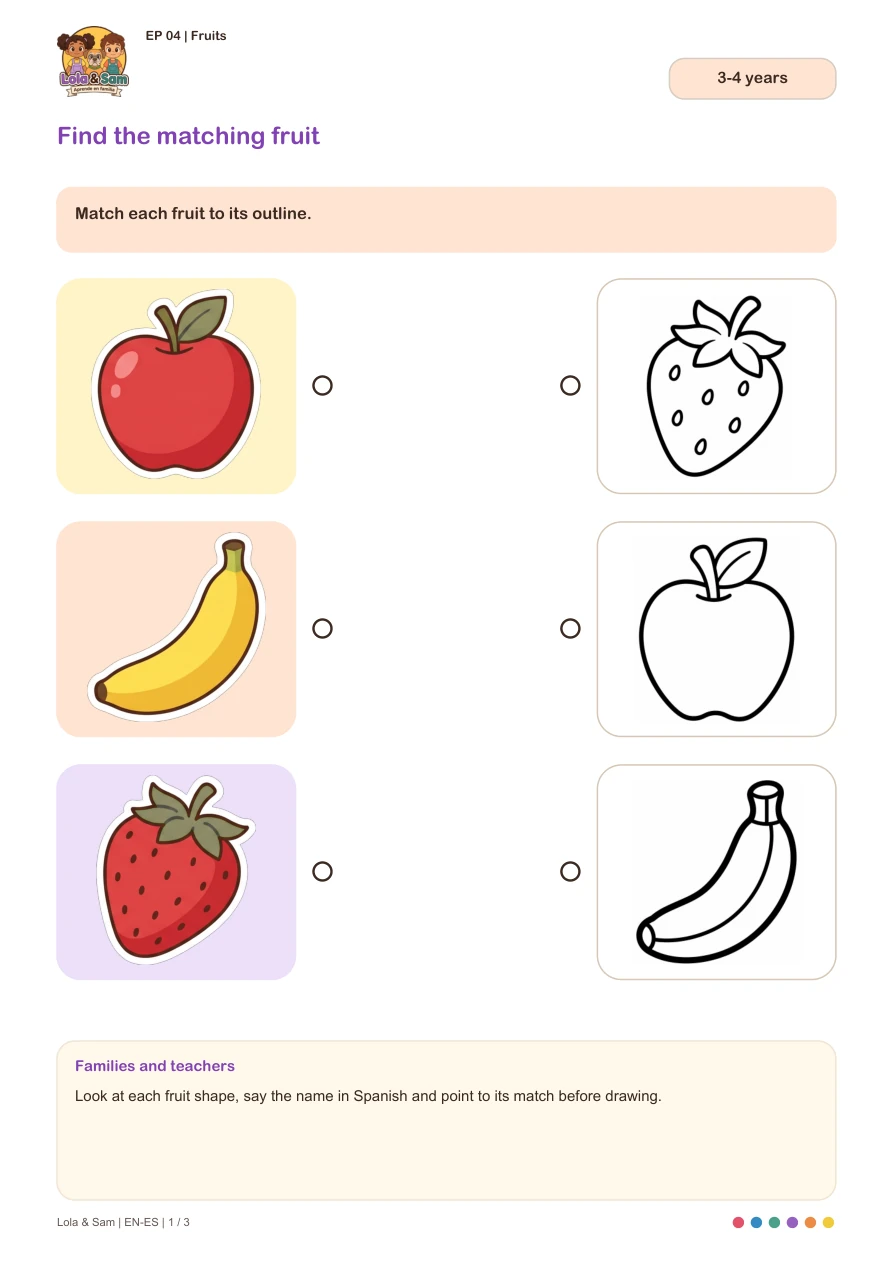
Matching games for 3–4 year olds: try “the matching table” with support matched to your child. Two apples may look like an obvious pair to an adult. For a child, finding them among several pictures invites a closer look at color, shape and details. We can use that search to start a conversation, keeping the cards face up and allowing children to explain their choices in their own way.
At a glance
- Suggested ages: 3–4 years.
- Materials: Three pairs of large fruit or toy pictures, prepared and cut out by an adult.
- Key idea: Place all six cards face up and choose one to begin. Name it in Spanish and English.
Matching games for 3–4 year olds: what to notice
Prepare three pairs and leave all the pictures visible. The first challenge is comparing, without also remembering where each card was hidden. If your child puts a strawberry with an apple, ask what they noticed: they may be grouping by color. Their answer helps you choose the next hint.
Offer a hint that keeps the game moving
Skene and colleagues describe guided play as combining children’s choices with flexible adult support. In this activity, you can reduce the choices or point out a detail instead of matching the cards yourself. Our game is an original adaptation, rather than a protocol evaluated in that review.
Source: Skene et al. (2022).
The matching table · setup and steps
You will need: Three pairs of large fruit or toy pictures, prepared and cut out by an adult.
- Place all six cards face up and choose one to begin. Name it in Spanish and English.
- Invite your child to find another that matches. Wait before offering a hint, and accept pointing as an answer.
- Put the two pictures together and talk about a shared detail: the wheels, the leaf or the shape.
- Swap roles: your child chooses a card and you find its match, explaining what you are looking at.
Words to share
Español: Busquemos otra manzana.
English: Let’s find another apple.
Español: ¿Qué tienen igual?
English: What is the same about them?
How to adapt it
Make it simpler
Use just two pairs and space the pictures out so they are easy to distinguish.
Extend the game
Use two different drawings of the same object and discuss why they represent the same thing.
At home
After playing, look for one of the objects among toys or pictures at home.
In the classroom
In pairs, one child can choose a card and the other find its match; then swap roles.
There is no need to answer quickly or repeat every name. Listening to how a child compares pictures can tell you more than counting completed pairs.
Activities to keep exploring

Sources and further reading
- Skene, K., O’Farrelly, C. M., Byrne, E. M., Kirby, N., Stevens, E. C., & Ramchandani, P. G. (2022). Can guidance during play enhance children’s learning and development in educational contexts? A systematic review and meta-analysis. Child Development, 93(4), 1162–1180. Read the study ↗
These games are Lola & Sam’s own suggestions. Course guides and professional guidance provide educational context; they do not establish the effectiveness of these activities. The cited studies do not evaluate our episodes or materials either.