
Games for 4–5 year olds: shapes and quantities
Build shapes and follow a numbered path with questions that encourage a closer look.
Families
Article by the Lola & Sam team. Sources at the end.
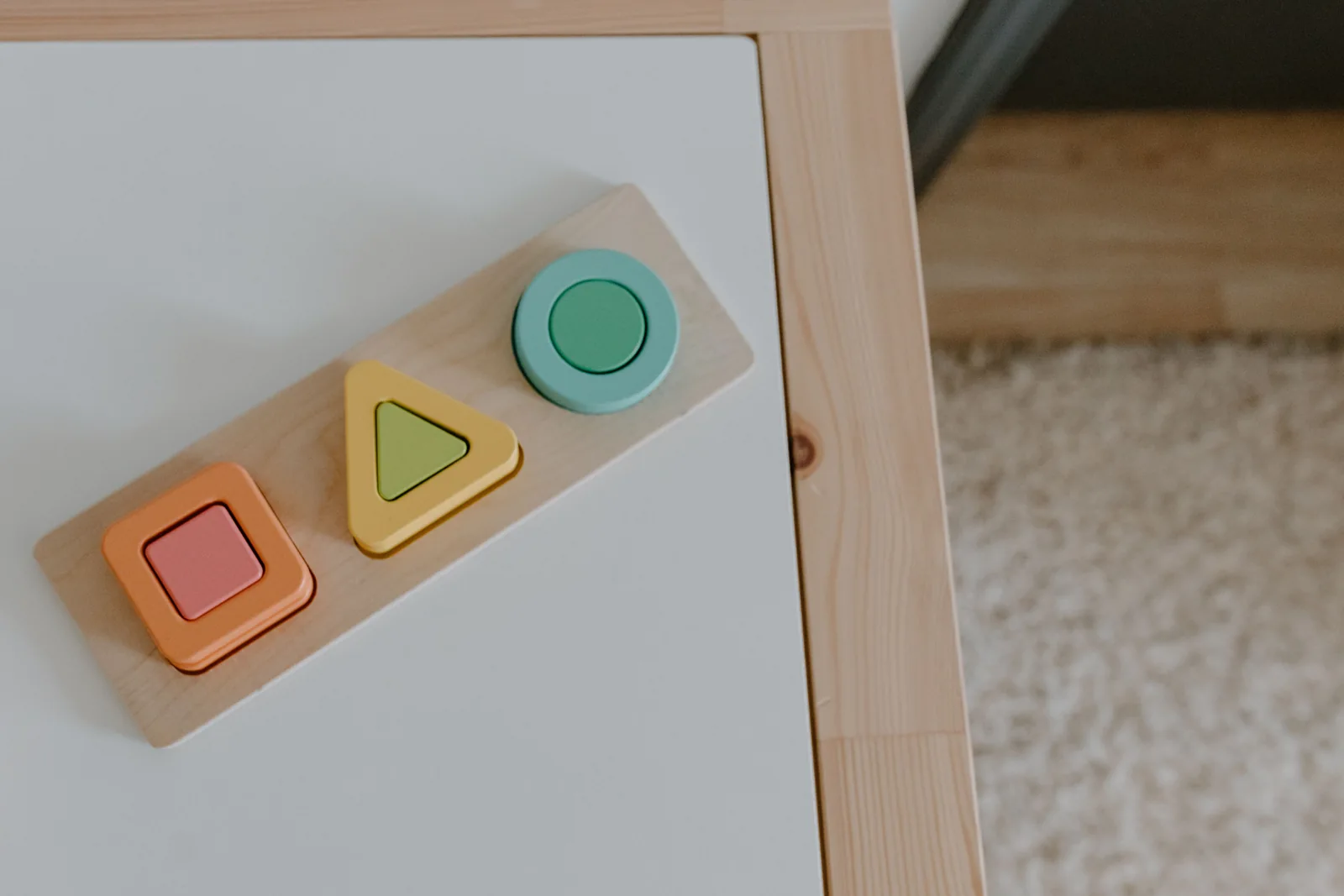
Games for 4–5 year olds: try “build a shape or follow the path” with support matched to your child. Does a triangle stop being a triangle when we turn it? How can we tell how many spaces we have moved? Shapes and quantities offer questions we can investigate with our hands. Here are two small games to try separately, depending on what sparks the most curiosity.
At a glance
- Suggested ages: 4–5 years.
- Materials: Wide strips of card; another sheet with six equal spaces numbered 1–6; one large piece to move.
- Key idea: For the shape game, offer three strips and ask whether you can make a closed shape with them.
Games for 4–5 year olds: what to notice
Fisher and colleagues found better shape-learning outcomes with guided play in a sample of 4–5-year-olds. In our game, asking “How many sides does it have?” invites attention beyond appearance. Show triangles in different orientations rather than always presenting a single model.
Source: Fisher et al. (2013).
A path where every move counts
Ramani and colleagues used linear numbered boards, specific instructions and adult support to work on numerical skills. We borrow the idea of linking movement with counting, without attributing the study’s results to our board. Say one number for each space moved and notice together where the move ends.
Source: Ramani et al. (2012).
Build a shape or follow the path · setup and steps
You will need: Wide strips of card; another sheet with six equal spaces numbered 1–6; one large piece to move.
- For the shape game, offer three strips and ask whether you can make a closed shape with them.
- Count its sides, turn the shape and notice what changes and what stays the same.
- For the path game, place the piece before the first space and choose to move one or two spaces.
- Touch each space as you move the piece. Count again if you want to check the move.
Words to share
Español: Tiene tres lados.
English: It has three sides.
Español: Vamos a avanzar dos casillas.
English: Let’s move forward two spaces.
How to adapt it
Make it simpler
Explore one shape or start with a three-space path and moves of one space.
Extend the game
Build another shape and compare sides, or ask how many spaces remain before the end.
At home
Look for shapes in everyday objects and discuss which part resembles the shape you built.
In the classroom
Set up two areas with different materials and support each group with a short question.
These activities invite exploration and conversation. If counting or building is difficult, reduce the materials and model one step at a time.
Activities to keep exploring


Sources and further reading
- Fisher, K. R., Hirsh-Pasek, K., Newcombe, N., & Golinkoff, R. M. (2013). Taking shape: Supporting preschoolers’ acquisition of geometric knowledge through guided play. Child Development, 84(6), 1872–1878. Read the study ↗
- Ramani, G. B., Siegler, R. S., & Hitti, A. (2012). Taking it to the classroom: Number board games as a small group learning activity. Journal of Educational Psychology, 104(3), 661–672. Read the study ↗
These games are Lola & Sam’s own suggestions. Course guides and professional guidance provide educational context; they do not establish the effectiveness of these activities. The cited studies do not evaluate our episodes or materials either.