
Guided play in preschool: when and how to help
An approach that combines a purpose, children’s choices and carefully adjusted hints.
Families and teachers
Article by the Lola & Sam team. Sources at the end.
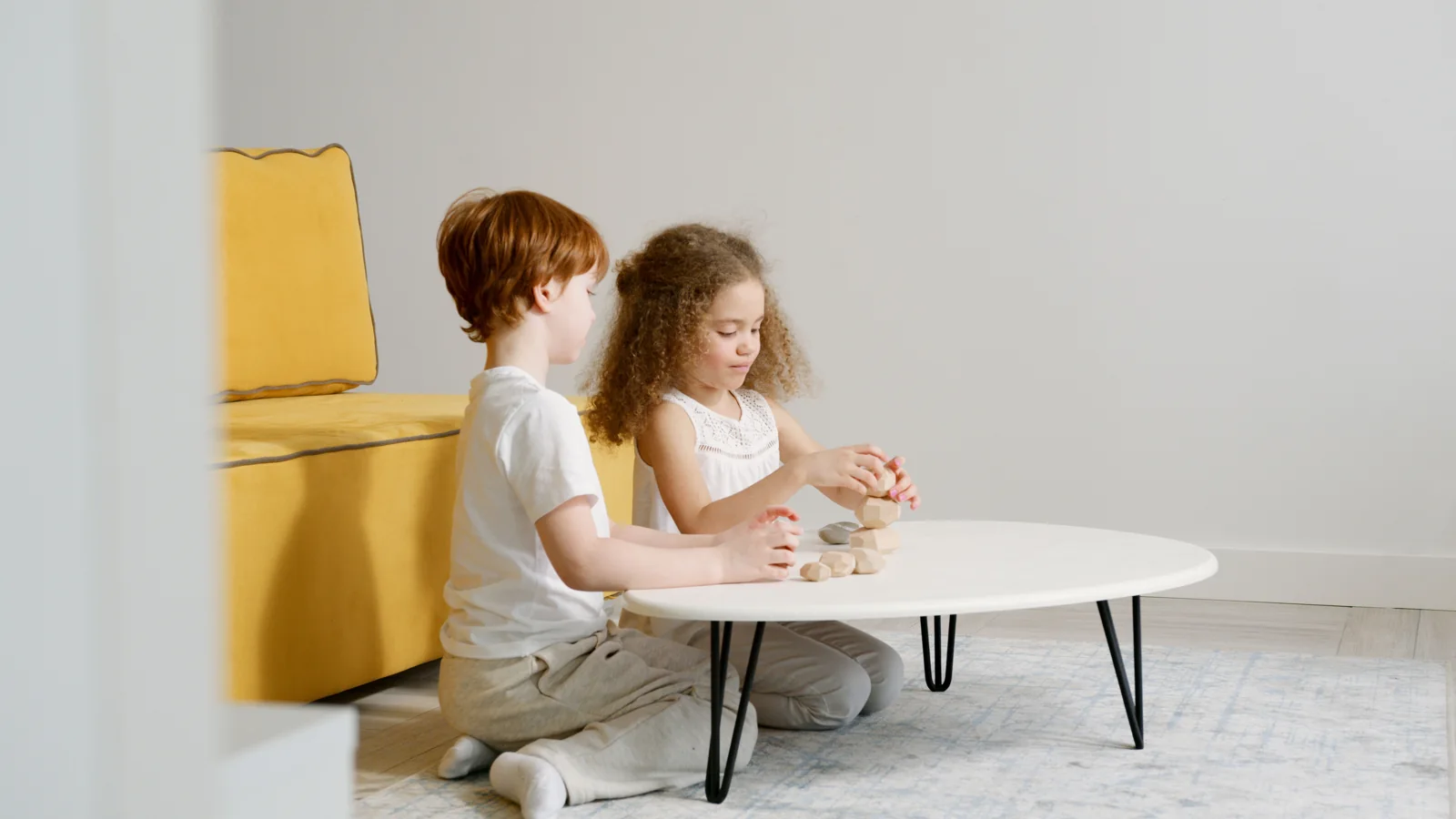
Guided play in preschool: try “build a paper house” with support matched to your child. Your child is trying to place a piece, and you can immediately see where it fits. Solving it would take a second, but you can also wait, watch their attempt and offer a hint. Guided play gives us a way to think about support while leaving room for children’s decisions.
At a glance
- Suggested ages: 2–3, 3–4, 4–5, 5–6, 6+ years.
- Materials: One large card square, one triangle and two rectangles; a sheet on which to arrange them.
- Key idea: Present the pieces and invite your child to invent a house. Let them choose where to start and move the elements.
Guided play in preschool: what to notice
Skene and colleagues characterize guided play through a learning goal, some child autonomy and flexible adult guidance. They found advantages for some outcomes, with variation across skills and studies; the review does not establish general superiority for every kind of learning.
Source: Skene et al. (2022).
Observe before choosing the support
Distinguish trying things out from being stuck. Turning a piece several times can be exploration. If your child asks for help or cannot find a way forward, offer a small intervention: “Let’s look at this edge.” Then give the turn back. Their response will show whether another hint or more time is needed.
Build a paper house · setup and steps
You will need: One large card square, one triangle and two rectangles; a sheet on which to arrange them.
- Present the pieces and invite your child to invent a house. Let them choose where to start and move the elements.
- Watch what they try. Make a specific comment before asking another question: “You put this piece at the top.”
- If help is needed, offer a hint about one piece and let your child decide what to do with it.
- When finished, discuss what you might change to build another house. Name the pieces in both languages if useful.
Words to share
Español: ¿Qué podríamos probar?
English: What could we try?
Español: Puedes girar esta pieza.
English: You can turn this piece.
How to adapt it
Make it simpler
Offer two pieces and begin a construction yourself so your child can add the next one.
Extend the game
Suggest building something that meets a condition you choose together, such as having two entrances.
At home
Weave questions into conversation and leave pauses; there is no need to comment on every move.
In the classroom
Prepare materials around a specific goal and notice how the support needed changes between groups.
Support can increase or fade within the same game. Let the child’s response guide it, rather than following a fixed sequence of questions.
Activities to keep exploring


Sources and further reading
- Skene, K., O’Farrelly, C. M., Byrne, E. M., Kirby, N., Stevens, E. C., & Ramchandani, P. G. (2022). Can guidance during play enhance children’s learning and development in educational contexts? A systematic review and meta-analysis. Child Development, 93(4), 1162–1180. Read the study ↗
These games are Lola & Sam’s own suggestions. Course guides and professional guidance provide educational context; they do not establish the effectiveness of these activities. The cited studies do not evaluate our episodes or materials either.