
OPOL: one person, one language and other family strategies
OPOL is one family option, without a bilingualism guarantee. Make a simple map of real opportunities to listen and talk.
Families and teachers
Article by the Lola & Sam team. Sources at the end.
OPOL: try “our conversation map” with support matched to your child. Spanish is spoken at home; one adult uses English with the child, but on some days they hardly see each other. “One person, one language” describes who uses each language, but it does not tell the whole story. To choose a routine, start with the people and moments actually available, without expecting every family to organise itself alike.
At a glance
- Suggested ages: 2–3, 3–4, 4–5, 5–6 years.
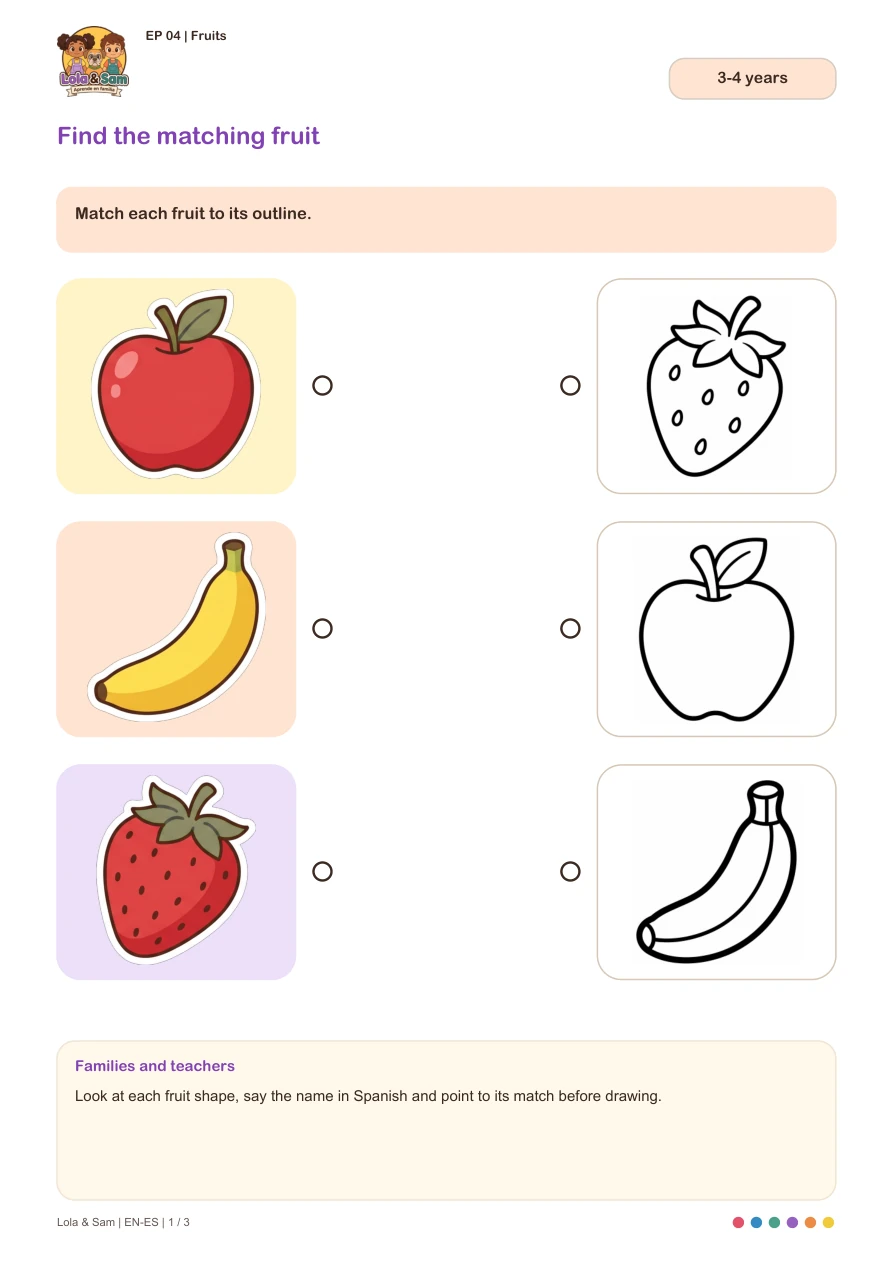
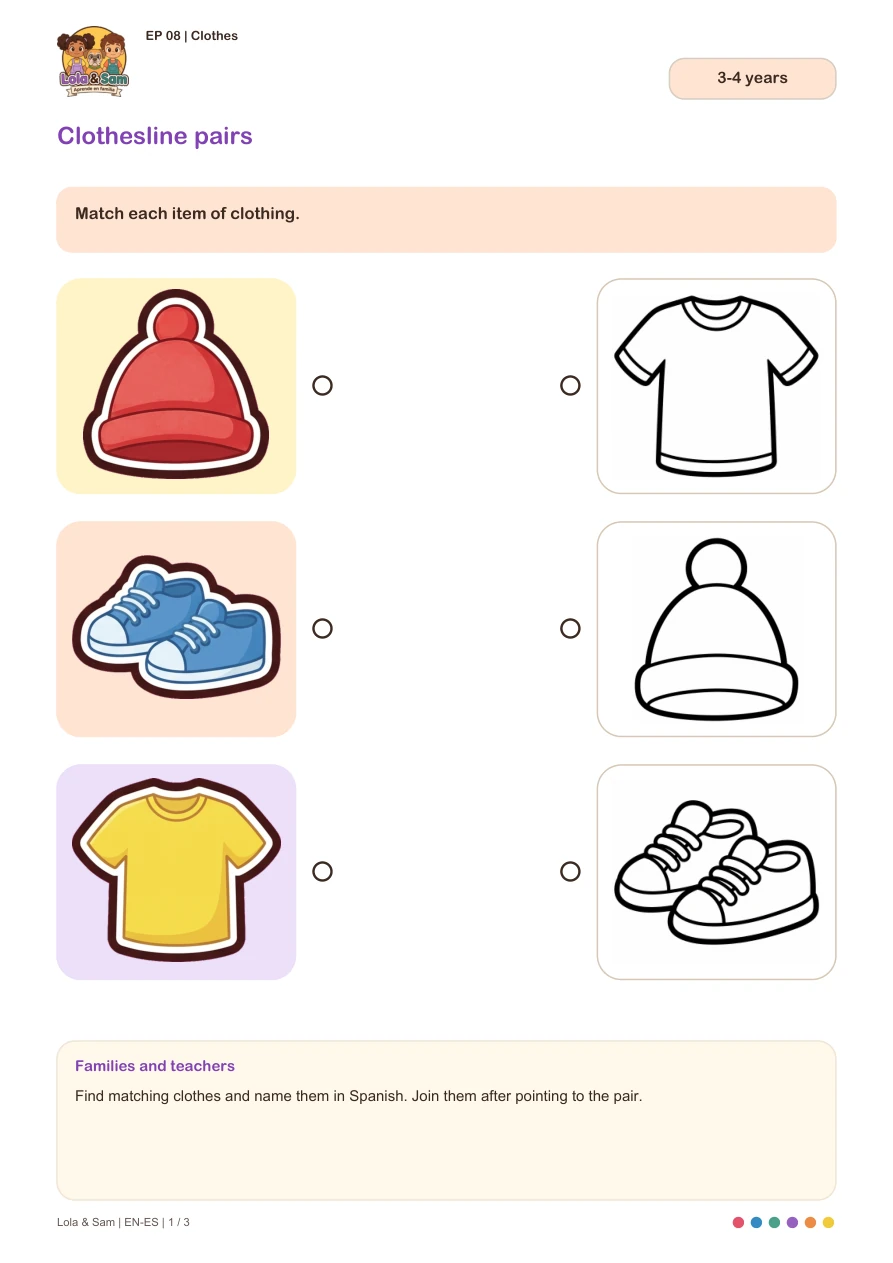
- Materials: A sheet of paper, pencils and drawings of people, clothes or fruit from episodes 08 and 04.
- Key idea: Draw the people your child spends time with together. Written names are optional.
OPOL: what to notice
De Houwer (2007) analysed questionnaires from 1,899 families with children aged 6–10. Home language patterns were associated with children’s use of the minority language. OPOL was neither necessary nor sufficient for children to speak both languages.
This observational study concerns children older than the audience for many of our games. We consulted the publisher’s abstract; it cannot show that changing strategy today will produce a particular preschool outcome. Nor does it turn one family arrangement into a universal recipe.
Source: De Houwer (2007).
Choose an arrangement you can sustain
As planning options, you could map one person to each language, reserve certain moments for one language or give more space at home to the language less available outside. First note who can converse comfortably and when. This is not about imposing exact percentages.
Choose one feasible moment and review it after trying: could you sustain the conversation, was there interest, and what was missing? If an adult switches language to comfort or explain, the routine can resume later. This flexibility is our practical proposal, not an experimental finding.
Source: De Houwer (2007).
Our conversation map · setup and steps
You will need: A sheet of paper, pencils and drawings of people, clothes or fruit from episodes 08 and 04.
- Draw the people your child spends time with together. Written names are optional.
- Add an object for a shared moment: a T-shirt for getting dressed or fruit for a snack.
- Choose one scene and act it out in a language the adult can use. Prepare a short phrase in the other if helpful.
- Mark the scene you want to repeat another day and agree who will be there. Leave the rest as possibilities.
Words to share
Español: ¿Con quién elegimos la fruta?
English: Who do we choose fruit with?
Español: Hoy lo probamos juntos.
English: Today we try it together.
How to adapt it
Make it simpler
Draw just one person and one moment. Your child can point.
Extend the game
Add the library, school or friends and discuss which language you can share in each place.
At home
Review the map when schedules or caregivers change; do not use it to monitor every word your child says.
In the classroom
Invite families to describe their arrangements without ranking them. Agree on one specific way to work together.
The map supports a small decision you can revise. Research challenges the idea that OPOL is compulsory; it does not guarantee any family routine’s outcome.
Activities to keep exploring
Sources and further reading
- De Houwer, A. (2007). Parental language input patterns and children’s bilingual use. Applied Psycholinguistics, 28(3), 411–424. University of Antwerp. DOI: 10.1017/S0142716407070221. Read the study ↗
These games are Lola & Sam’s own suggestions. Course guides and professional guidance provide educational context; they do not establish the effectiveness of these activities. The cited studies do not evaluate our episodes or materials either.