
Preschool pattern activities: discovering what repeats
Games with colors, shapes and movements for copying, continuing and creating sequences with a repeating part.
Families and teachers
Article by the Lola & Sam team. Sources at the end.
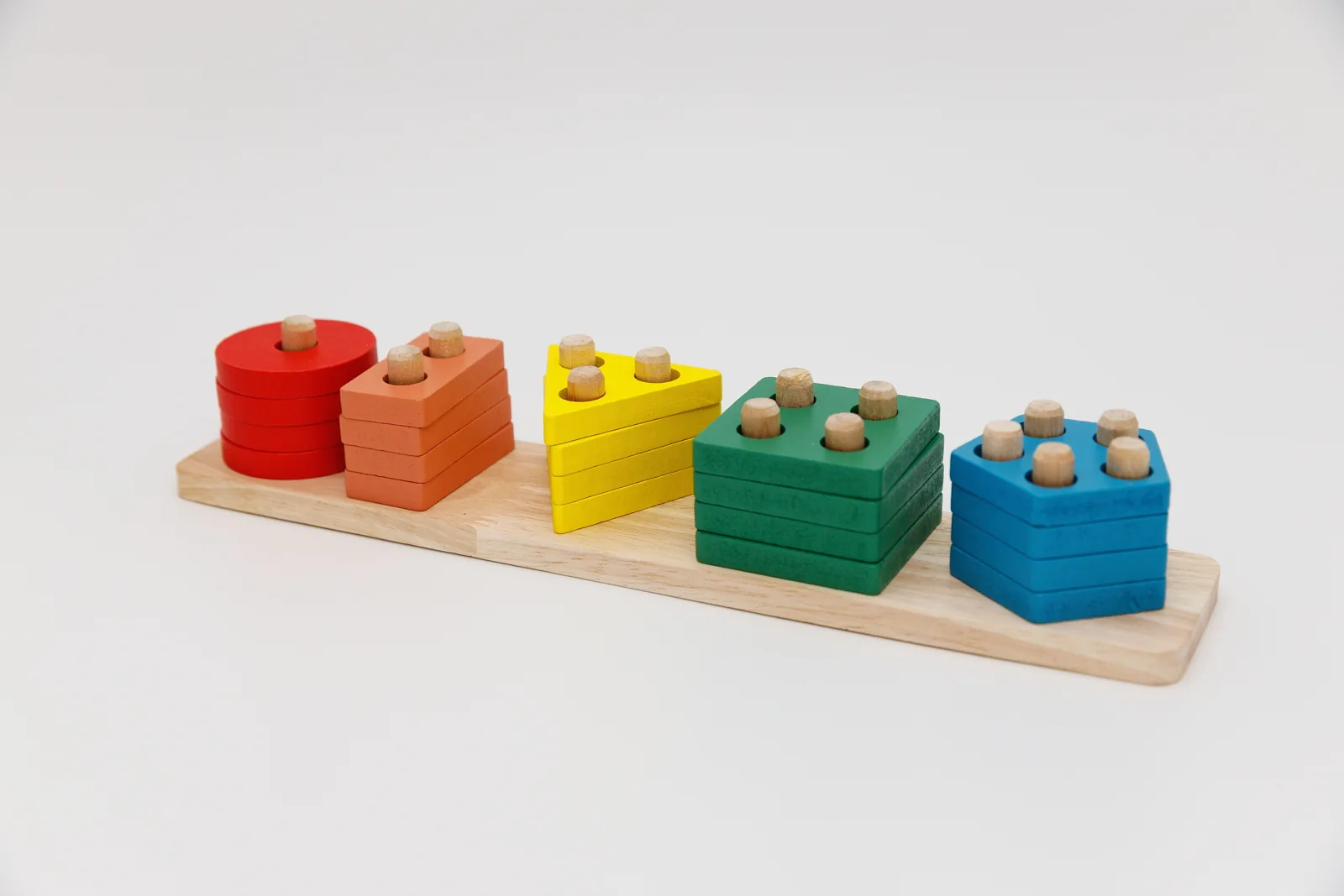
Preschool pattern activities: try “the row that starts again” with support matched to your child. Circle, square, circle, square… One child adds another circle; another places a triangle because they like its colour. Before deciding whether an answer is correct, make the purpose clear: decorating freely and continuing a rule are different activities. Exploring patterns needs a repeating part and an invitation to discover it. There is no need to begin with labels such as ABAB. Shapes, sounds and movements can all show the same idea in a more concrete way.
At a glance
- Suggested ages: 3–4, 4–5, 5–6 years.
- Materials: Large circle and square cards in the same colour, a clear surface and room to keep a model. An adult prepares the cards.
- Key idea: Build a row of three pairs: circle and square. Trace it with a finger and name the shapes, keeping the model visible.
Preschool pattern activities: what to notice
Zippert and colleagues studied 211 preschoolers across five teaching sessions. The authors reported specific gains in patterning, but no additional advantage in general mathematics. What Works Clearinghouse rated the study with reservations and found no statistically significant positive findings in the measures it reviewed. These analyses should be distinguished; practising sequences does not come with a promise of improving every area of mathematics.
Source: Zippert et al. (2021); What Works Clearinghouse · Zippert review (2023).
Find the part that starts again
Our activity starts with two clearly different shapes. Repeat the small group several times and leave gaps between groups if that helps children see them. Trace the row with a finger, naming each shape slowly. Then use your hand to indicate the pair that keeps appearing. This is our own suggestion for making the rule visible; it does not reproduce the research protocol.
A child may copy a whole row without yet noticing the repeating part. Instead of asking for many more pieces, ask where the same group would start again. You can move one pair aside to compare it with the next section. If the instruction feels confusing, build another shorter row together before trying again.
Change materials while keeping the rule
Once the sequence is familiar, invite children to make another using different materials: a circle and square can become a clap and a tap on the knees. An adult demonstrates one group before the child tries it. The question is what stays the same in the repetition, rather than how many elements everyone can remember without looking.
When someone invents a different rule, ask them to demonstrate it and build alongside them. Pieces can be organised in more than one way, so listen to the proposal before correcting it. When the purpose is to continue the original pattern, return to the model and compare one small section. The model can remain visible throughout the activity.
Colors and shapes from Lola & Sam
A colour or shape episode can provide vocabulary and pictures for later play at a table. Choose a few elements and avoid changing colour and shape at the same time at first. You can offer each shape’s name in the language you are learning while keeping explanations in the more familiar language when needed. Naming and discovering the rule are related purposes, but they do not need to be assessed at the same time.
The row that starts again · setup and steps
You will need: Large circle and square cards in the same colour, a clear surface and room to keep a model. An adult prepares the cards.
- Build a row of three pairs: circle and square. Trace it with a finger and name the shapes, keeping the model visible.
- Point to a pair and find it again in the row. The child can respond by speaking, pointing or placing two matching cards near the model.
- Offer a few cards and invite the child to continue. If they choose a different shape, ask about their rule and compare it with the model.
- Build another row together using a different pair. When it feels comfortable, try representing that repetition with two movements.
- Take a photo of the row if you want to return to it another day. Recall which part started again, without adding a final test.
Words to share
Español: ¿Qué parte se repite?
English: Which part repeats?
Español: Aquí empieza otra vez.
English: It starts again here.
Español: ¿Podemos hacer la misma regla con movimientos?
English: Can we show the same rule with movements?
How to adapt it
Make it simpler
Leave visible gaps between pairs and make space for just one missing card. Offer that card alongside one clearly different option and keep the full model visible.
Extend the game
Move from a pair to a group of three elements, or change materials while keeping the repetition. Introduce one variation at a time.
At home
Make a short row on a tray and let the child suggest the next one. Offer Spanish or English words without asking for translations.
In the classroom
Set up tables with the same pattern and different supports. Notice who copies, continues or identifies the repeating part, without turning this into fixed labels.
A sequence becomes interesting when we can talk about its rule, represent it and change it. Mistakes help us understand the idea a child was following and choose a useful example to offer next.
Activities to keep exploring


Sources and further reading
- Zippert, E. L., Douglas, A.-A., Tian, F., & Rittle-Johnson, B. (2021). Helping preschoolers learn math: The impact of emphasizing the patterns in objects and numbers. Journal of Educational Psychology, 113(7), 1370–1386. DOI: 10.1037/edu0000656. Read the study ↗
- What Works Clearinghouse. (2023, January). Study 90346: Helping preschoolers learn math: The impact of emphasizing the patterns in objects and numbers. Institute of Education Sciences, U.S. Department of Education. Read the study ↗
These games are Lola & Sam’s own suggestions. Course guides and professional guidance provide educational context; they do not establish the effectiveness of these activities. The cited studies do not evaluate our episodes or materials either.