
Preschool puzzle activities: turning, fitting and helping
Ways to support puzzle play with words, clues and suitable pieces while respecting how each child explores.
Families and teachers
Article by the Lola & Sam team. Sources at the end.
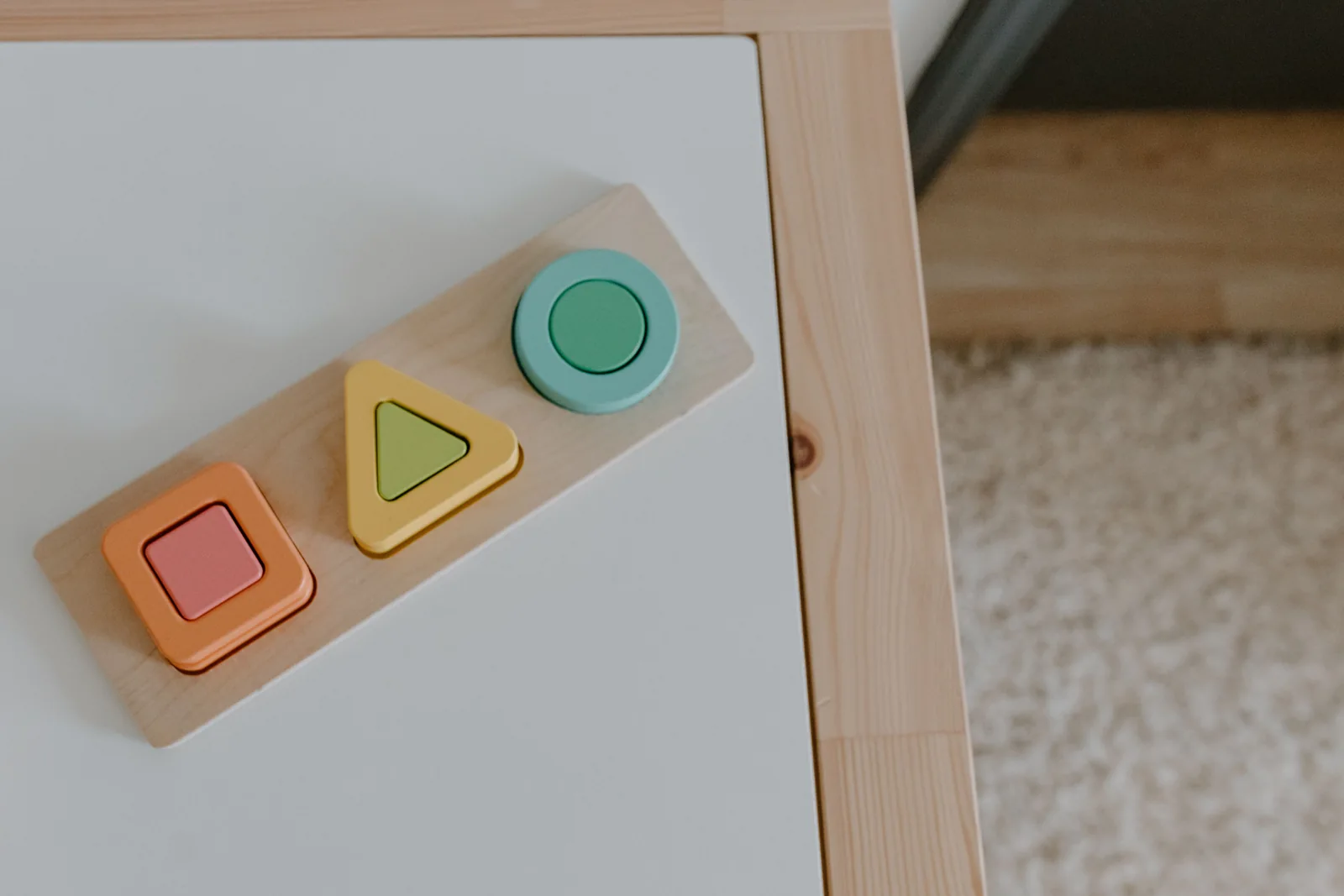
Preschool puzzle activities: try “rebuild a familiar picture” with support matched to your child. A piece almost fits. A child pushes it, picks it up and tries the same space again. Before placing it ourselves, we can consider which clue would help them keep exploring: looking at an edge, comparing the piece with a gap or slowly turning it. Puzzles offer many chances to try different approaches. A useful challenge depends on more than the number of pieces. Their size, the picture, the available model and the help we offer all matter.
At a glance
- Suggested ages: 2–3, 3–4, 4–5, 5–6 years.
- Materials: A large picture of a toy or shape, one complete copy as a model and another cut by an adult into a few large pieces. A stable surface.
- Key idea: Look at the complete picture and let the child choose where to begin. Name one detail that catches your attention.
Preschool puzzle activities: what to notice
Levine and colleagues followed 53 families, observing play between 26 and 46 months. Children seen playing with puzzles performed better on a spatial transformation task at four and a half, after accounting for some family differences. This was an observational study: it found an association rather than proving puzzles caused the advantage. It did not evaluate Lola & Sam materials.
Source: Levine et al. (2012).
Choose a manageable starting point
For our activity, choose large, sturdy, age-appropriate pieces without small parts that could come loose. A familiar picture with a few clearly different areas can be a useful starting point. Keep a complete model nearby and present only the pieces you plan to use. An adult handles cutting and any laminating when preparing a homemade puzzle.
Watch what the child does before stepping in. They might start with a face, look for a colour or compare sizes. There is no need to insist on finding corners first. Describe one possibility and let them decide whether to try it: “This piece has a straight edge.” If they ask you to place a piece, explain your action as you do it and then return the opportunity to explore.
Clues that leave something to work out
You can adjust support without changing the puzzle: bring two related pieces closer, leave the gap visible or point to the matching area on the model. Pause after each clue. Giving three instructions in a row makes it hard to see which one helped. If the child becomes tired or loses interest, putting an unfinished puzzle away is a reasonable choice.
Afterwards, mention an action you noticed: turning, comparing, trying another gap or asking for help. This conversation does not need to become a vocabulary test. The child can show with their hands how they found a solution. Next time, keep the same picture or change one feature, such as covering part of the model when it is no longer needed.
A familiar picture as an invitation
After a Lola & Sam episode about shapes or toys, choose a related picture for a puzzle. This connection offers continuity and something familiar to talk about. Spanish and English words can accompany the activity: first make sure the action is understood, then offer a short expression. Fitting a piece does not depend on saying the word.
Rebuild a familiar picture · setup and steps
You will need: A large picture of a toy or shape, one complete copy as a model and another cut by an adult into a few large pieces. A stable surface.
- Look at the complete picture and let the child choose where to begin. Name one detail that catches your attention.
- Place the pieces picture-side up. Invite the child to find a recognisable part without showing where it must go.
- When a piece does not fit, offer one clue: check the model, compare the edge or try turning it. Allow time to experiment.
- Join the parts the child discovers. If help is needed, do only the agreed action and leave the remaining pieces within reach.
- Look at the result or put the unfinished work away. Ask which piece they might look for first another time.
Words to share
Español: ¿Qué pasa si la giramos?
English: What happens if we turn it?
Español: Este borde es recto.
English: This edge is straight.
Español: Podemos mirar el modelo.
English: We can look at the model.
How to adapt it
Make it simpler
Offer two large parts over a visible outline. Bring a piece close to its matching space so the child can complete the final movement.
Extend the game
Gradually remove the model or add a few pieces. Invite the child to demonstrate a strategy before also making the picture more complex.
At home
Keep the puzzle on a tray if you need to stop. Continue another day from the same point, recalling a clue you already discovered.
In the classroom
Prepare puzzles on the same theme with different supports. Notice how each child orients a piece, without comparing completion speeds.
A puzzle offers a chance to explore how parts relate to a whole. Helpful support leaves room to keep trying and notice a personal strategy, even when only a few pieces find their places today.
Activities to keep exploring


Sources and further reading
- Levine, S. C., Ratliff, K. R., Huttenlocher, J., & Cannon, J. (2012). Early puzzle play: A predictor of preschoolers’ spatial transformation skill. Developmental Psychology, 48(2), 530–542. DOI: 10.1037/a0025913. Read the study ↗
These games are Lola & Sam’s own suggestions. Course guides and professional guidance provide educational context; they do not establish the effectiveness of these activities. The cited studies do not evaluate our episodes or materials either.