
Preschool screen time: how much and how to watch together
WHO and AAP guidance on screens, plus a way to share a video through conversation and play away from the screen.
Families and teachers
Article by the Lola & Sam team. Sources at the end.

Preschool screen time: try “from a screen colour to a room colour” with support matched to your child. The episode ends and another video appears. Before pressing play, decide what to watch, when to stop and what to do afterwards. Sharing a video does not require turning every scene into a quiz. This activity is for families who have already chosen to use a video, and it can also be done entirely with printed pictures.
At a glance
- Suggested ages: 2–3, 3–4, 4–5 years.
- Materials: Two large objects of different colors and, if already chosen, a segment from episode 01.
- Key idea: Before starting, show the objects and agree to look for something similar after the segment.
Preschool screen time: what to notice
WHO (2019) recommends no sedentary screen time under age two. For two-year-olds and for three- and four-year-olds, it recommends at most one hour daily; less is better. This is a limit, not an amount to fill.
The guidance covers children under five and considers movement, sedentary behaviour and sleep together. It does not establish an educational dose of videos or justify extending the limit because content is bilingual.
Source: OMS / WHO (2019).
Sharing also means choosing and stopping
The AAP’s 2026 policy updates its 2016 statement. It prioritises quality content, conversation and protecting sleep, play and physical activity; it discusses limits suited to each family and mentions under an hour daily for toddlers and preschoolers. Sharing media can support relationships and learning, without guaranteeing outcomes.
Our game carries an idea from a video into real objects. Choose a segment beforehand, turn off autoplay and prepare the materials. These steps are our team’s proposal; they are not a tested intervention or a reason to add screen time.
Source: Munzer et al. / AAP (2026).
From a screen colour to a room colour · setup and steps
You will need: Two large objects of different colors and, if already chosen, a segment from episode 01.
- Before starting, show the objects and agree to look for something similar after the segment.
- At a natural pause, comment on a colour and wait. Accept a look, gesture or word.
- Close the video at the agreed endpoint. Find the rojo/red object and put it beside the azul/blue one.
- Let your child invent something to do with them. If they want more, continue with the objects.
Words to share
Español: Aquí hay algo rojo.
English: Here is something red.
Español: El vídeo ha terminado. Ahora buscamos juntos.
English: The video has finished. Now we look together.
How to adapt it
Make it simpler
Use one object and name it while pointing. There is no need to ask a question.
Extend the game
Find colors in different places and compare two objects without reopening the video.
At home
Prepare the ending beforehand and offer a specific play option. If screens do not fit today, use the picture sheets.
In the classroom
Share the purpose with families and offer the same activity with pictures for those who do not use videos.
A short conversation and a predictable ending can be today’s plan. The sources inform media use; they have not evaluated Lola & Sam episodes or activities.
Activities to keep exploring
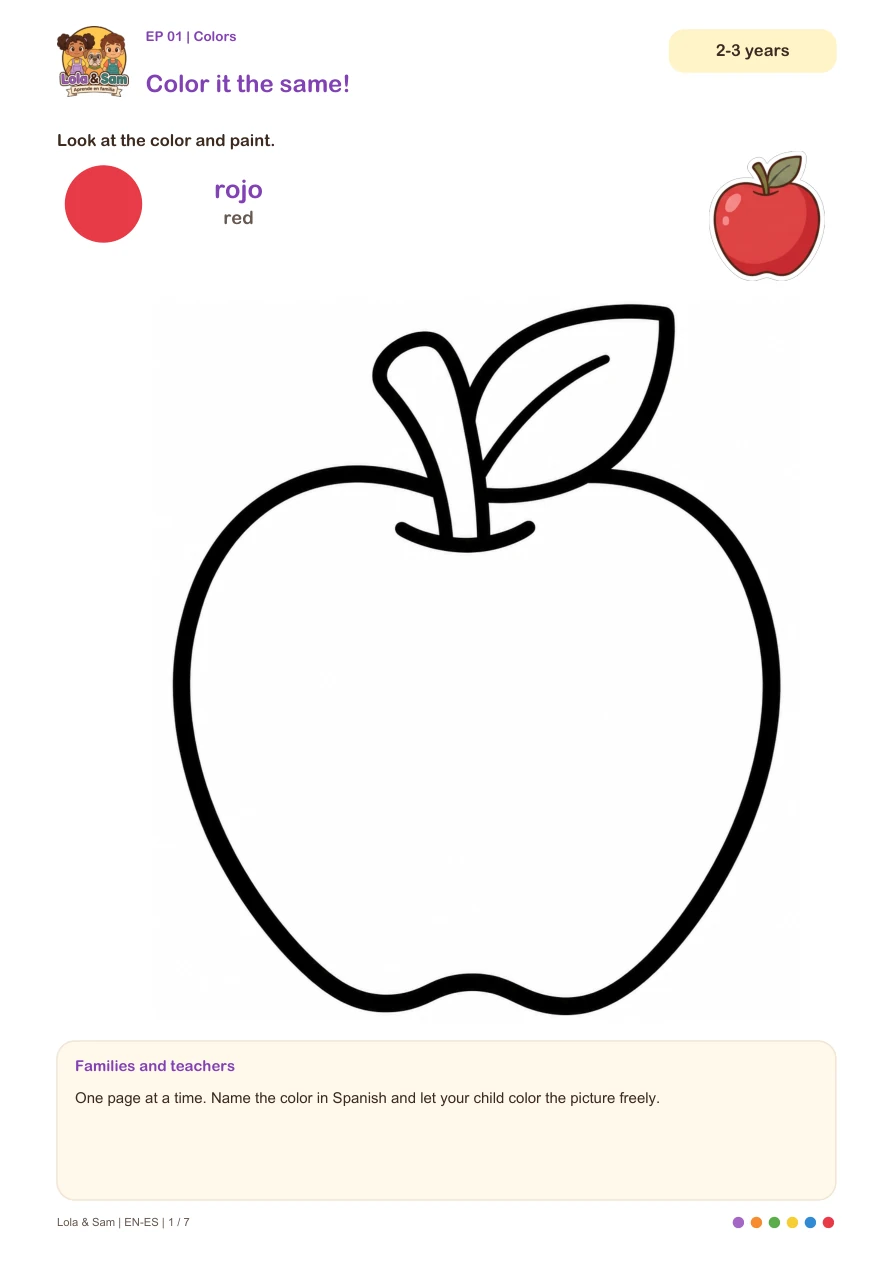
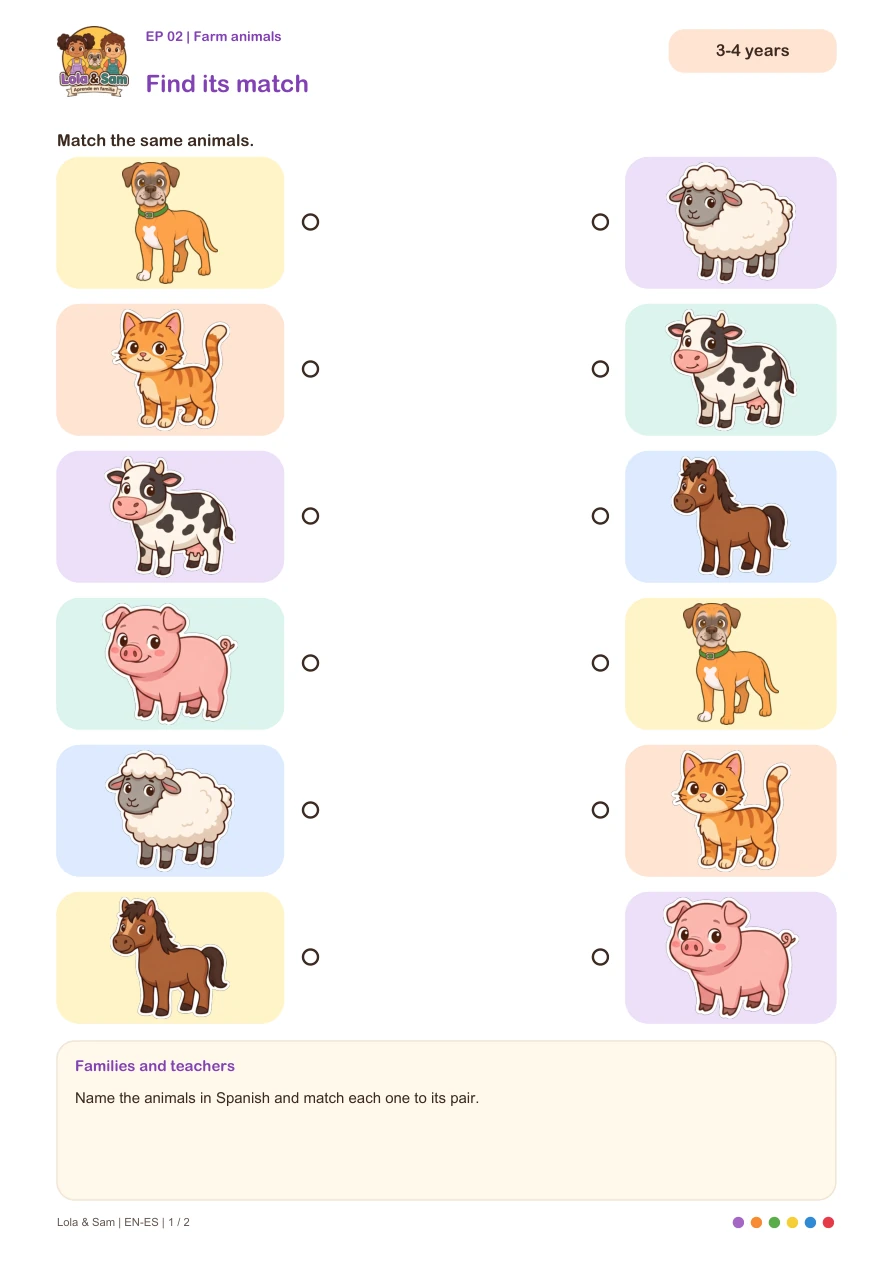
Sources and further reading
- World Health Organization. (2019). Guidelines on physical activity, sedentary behaviour and sleep for children under 5 years of age. Geneva: World Health Organization. ISBN 978-92-4-155053-6. Read the educational guidance ↗
- Munzer, T., Parga-Belinkie, J., Milkovich, L. M., Tomopoulos, S., Ajumobi, T., Cross, C., Gerwin, R., Madigan, S., & Council on Communications and Media. (2026). Digital Ecosystems, Children, and Adolescents: Policy Statement. Pediatrics, 157(2), e2025075320. American Academy of Pediatrics. DOI: 10.1542/peds.2025-075320. Read the educational guidance ↗
These games are Lola & Sam’s own suggestions. Course guides and professional guidance provide educational context; they do not establish the effectiveness of these activities. The cited studies do not evaluate our episodes or materials either.