
Shape activities for preschool: playing in two languages
Build a scene with circles, squares and triangles, using words and gestures in Spanish and English.
Families and teachers
Article by the Lola & Sam team. Sources at the end.
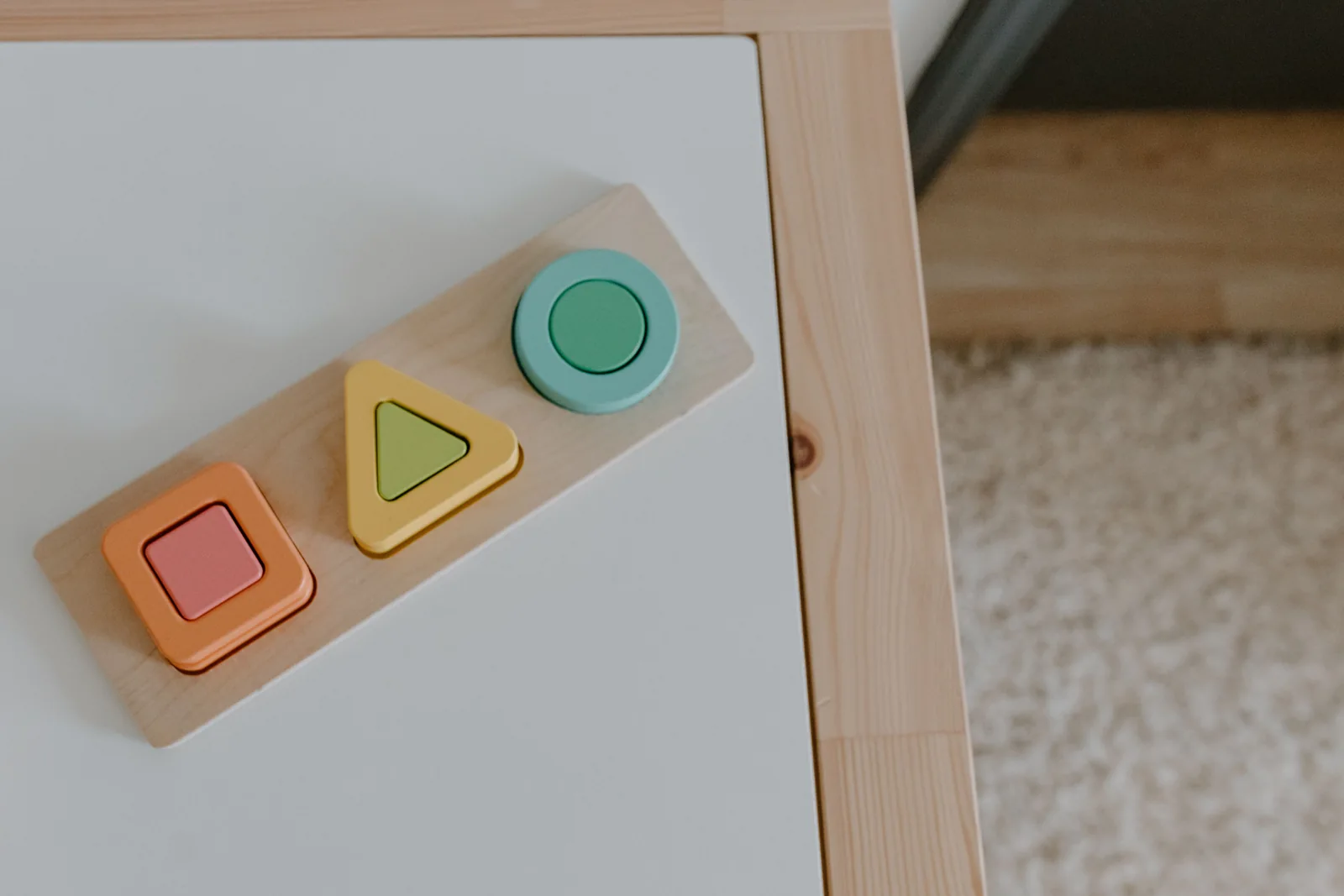
Shape activities for preschool: try “a landscape of shapes” with support matched to your child. A circle can become a wheel; a triangle can become a roof. As your scene takes shape, there are reasons to choose, compare and ask for another piece. Try playing with the shapes from episode 03 and supporting those decisions in Spanish and English. You can return to the same idea in both languages during the game without translating every turn.
At a glance
- Suggested ages: 3–4, 4–5, 5–6 years.
- Materials: Large paper shapes prepared by an adult, a sheet of paper and the pictures from episode 03 as a reference.
- Key idea: Lay out a few shapes. Explore their edges and name círculo/circle, cuadrado/square and triángulo/triangle.
Shape activities for preschool: what to notice
UNIR’s English guide includes CLIL and thematic learning; its mathematics guide covers geometry. These are curricular references. Our activity brings together a content purpose—comparing shapes—and a communication purpose—requesting or describing a piece—without claiming to be a validated CLIL program.
Begin with shapes in one color so attention can stay on their shape. Later, add colors and sizes. Turn a triangle around and ask what changes. In this game, recognizing a shape and knowing its name in each language are things you can notice separately.
Source: UNIR · Didáctica de la Lengua Inglesa; UNIR · Desarrollo del Pensamiento Matemático en Educación Infantil.
Words that help you build
NAEYC’s guidance supports participation through languages, pictures and gestures. In our scene, point to a piece as you name it and let your child respond by placing it, pointing or speaking.
Give both languages similar opportunities. If you say “un círculo grande” on one turn, return to “a big circle” with another piece later. A Spanish response can receive an English comment, and vice versa, without making repetition a condition for continuing the construction.
A landscape of shapes · setup and steps
You will need: Large paper shapes prepared by an adult, a sheet of paper and the pictures from episode 03 as a reference.
- Lay out a few shapes. Explore their edges and name círculo/circle, cuadrado/square and triángulo/triangle.
- Invite your child to build something they choose: a house, a vehicle or an imaginary landscape.
- Request a piece with a short phrase and a gesture. Then swap roles so your child can request one from you.
- Look at the composition and comment on one decision in each language. Save the pieces to build something different another day.
Words to share
Español: ¿Dónde pondrías el círculo?
English: Where would you put the circle?
Español: Necesito otro triángulo.
English: I need another triangle.
How to adapt it
Make it simpler
Offer two different shapes and demonstrate a choice with your own piece.
Extend the game
Compare rotated shapes or different sizes and invite an explanation in whichever language your child prefers.
At home
Look for similar shapes in objects around the room, then return to the paper pieces.
In the classroom
Build scenes in pairs and keep a small visual ES/EN word bank within everyone’s reach.
The finished scene can be very simple. Afterwards, recall how your child chose a piece, what comparison they made and which word or gesture helped them share an idea.
Activities to keep exploring


Sources and further reading
- Universidad Internacional de La Rioja (UNIR). Didáctica de la Lengua Inglesa. Public course guide for the Degree in Early Childhood Education. Accessed November 16, 2026. Read the course guide ↗
- Universidad Internacional de La Rioja (UNIR). Desarrollo del Pensamiento Matemático en Educación Infantil. Public course guide for the Degree in Early Childhood Education. Accessed November 16, 2026. Read the course guide ↗
- National Association for the Education of Young Children (NAEYC). DAP: Teaching to Enhance Each Child’s Development and Learning. Developmentally Appropriate Practice position statement. Read the educational guidance ↗
These games are Lola & Sam’s own suggestions. Course guides and professional guidance provide educational context; they do not establish the effectiveness of these activities. The cited studies do not evaluate our episodes or materials either.