
Preschool participation: different ways to respond
One picture can invite pointing, placing, speaking or drawing, while keeping the activity’s purpose clear.
Teachers
Article by the Lola & Sam team. Sources at the end.

Preschool participation: try “choose how to show it” with support matched to your child. You show an apple card. One child points, another places its match and another says “apple.” Before asking everyone for the same response, clarify what you are exploring. If the aim is matching two pictures, there are different ways to show a choice. If the aim is writing, children also need an opportunity to write with suitable support.
At a glance
- Suggested ages: 2–3, 3–4, 4–5, 5–6, 6+ years.
- Materials: One large fruit or toy picture, two choice cards, ES/EN labels and paper within reach.
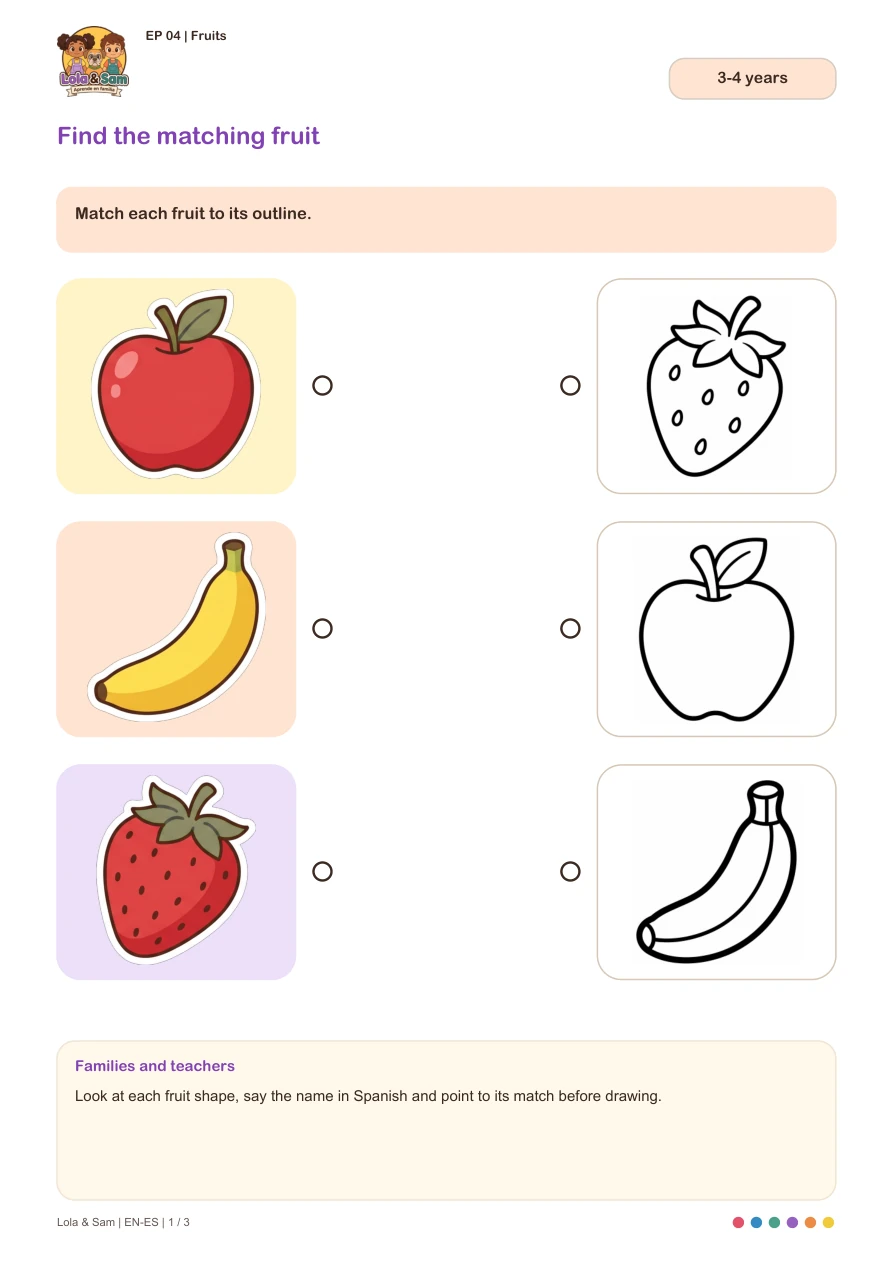
- Key idea: Introduce a shared question: “Which one matches?” Show the two options with space between them.
Preschool participation: what to notice
UNIR’s equality and diversity guide addresses inclusive participation. NAEYC proposes different forms of representation and expression. For our game, first decide which relationship children will explore, then offer response options that let them show it.
For example, present a fruit and two cards to find its match. A child can move a card closer, point or indicate a choice using their usual communication system. The question stays the same while the response method varies. Ask the family and supporting professionals about supports already in use.
Source: UNIR · Igualdad y Diversidad en el Aula; NAEYC · Teaching to Enhance Development.
Keep the observation specific
Finding a match alone does not establish naming, reading or writing. NAEYC recommends attending to languages and context when observing responses. Record what actually happened and which help was available, without adding skills you did not observe.
When adding ES/EN words, give both the same size and space. Show a picture, word and gesture, and alternate the language of invitations. Offering several routes does not make every task interchangeable: drawing and writing requests have their own purposes.
Source: NAEYC · Observing and Assessing.
Choose how to show it · setup and steps
You will need: One large fruit or toy picture, two choice cards, ES/EN labels and paper within reach.
- Introduce a shared question: “Which one matches?” Show the two options with space between them.
- Explain that children can point, move a card closer or communicate their choice in their usual way.
- Name the chosen picture in both languages. Offer a turn in each language without requiring repetition to participate.
- Then offer an optional extension: draw the object, describe it or prepare its label. Make the new purpose clear.
Words to share
Español: Puedes señalar la que eliges.
English: You can point to the one you choose.
Español: Muéstrame cómo lo has pensado.
English: Show me how you worked it out.
How to adapt it
Make it simpler
Reduce background distractions and adjust card size or spacing to make choosing easier.
Extend the game
Add a third option or invite an explanation through examples, words or the child’s usual communication system.
At home
Try two familiar toys and allow time for a choice before asking again.
In the classroom
Prepare different response routes from the start and review whether materials, positioning and turns allow participation.
A shared activity can include different contributions. Keeping the purpose clear and describing responses precisely helps you adjust support and recognize each child’s participation.
Activities to keep exploring

Sources and further reading
- Universidad Internacional de La Rioja (UNIR). Igualdad y Diversidad en el Aula. Public course guide for the Degree in Early Childhood Education. Accessed November 16, 2026. Read the course guide ↗
- National Association for the Education of Young Children (NAEYC). DAP: Teaching to Enhance Each Child’s Development and Learning. Developmentally Appropriate Practice position statement. Read the educational guidance ↗
- National Association for the Education of Young Children (NAEYC). DAP: Observing, Documenting, and Assessing Children’s Development and Learning. Developmentally Appropriate Practice position statement. Read the educational guidance ↗
These games are Lola & Sam’s own suggestions. Course guides and professional guidance provide educational context; they do not establish the effectiveness of these activities. The cited studies do not evaluate our episodes or materials either.